Guide for restaurant owners
Menu descriptions a formula and 32 before and after examples
Good menu descriptions tell a customer what the dish is, how it is made and what makes yours different, in under about 25 words. This guide gives you the formula, 32 menu description examples rewritten from weak to strong, the words to cut, and how to handle allergens, phone screens and a second language.
Last updated October 2026 · 10 minute read

Key takeaways
- A description has three parts: what it is, how it is made, what makes it yours.
- Keep it to 12 to 25 words. That is one or two lines on a phone.
- Replace every empty word, like delicious or famous, with a fact: a method, a time, a place, a portion.
- Name the ingredients people react to. Tahini is sesame, kibbeh has wheat, Caesar dressing has fish and egg.
- Keep a dish's own name. Fattoush stays fattoush, and the description explains it.
To write a menu description, answer three questions in one or two sentences: what is it, how is it made, and what makes yours different. Keep the whole thing under about 25 words and put the main ingredient or the cooking method first. That is enough for a customer to decide without asking.
The menu description formula
What it is + how it is made + what makes it yours, in under 25 words
Shish taouk, 23 words
1What it is
Two skewers of chicken breast
The customer knows the dish and the portion.
2How it is made
in a yoghurt, garlic and lemon marinade, grilled over charcoal.
Method tells them taste and texture, and names the dairy.
3What makes it yours
With our garlic sauce, made here every morning.
One true detail no other menu has.
The third part is where most menus stop short. It does not need to be grand. A sauce you make every morning, the village your olive oil comes from, the hours a ragu spends on the stove: one true detail is enough, and a customer can taste whether it is true.
Skip the name of the dish in the description. The name is already printed above it, and repeating it spends three or four of your 25 words.
Each card below takes a thin menu description and rewrites it with the formula. The dishes include the ones people most often look up, such as tiramisu, Caesar salad, lasagna and crème brûlée, and Lebanese dishes from hummus to knafeh. Copy the structure and change the facts to match your kitchen.
Starters and mezze
Hummus
Before
Chickpea dip.
After · 20 words
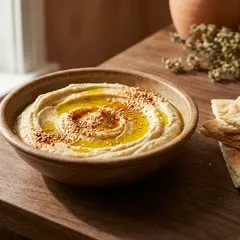
Chickpeas blended with tahini and lemon until smooth, finished with olive oil and toasted pine nuts. Served with warm bread.
Names the tahini and the pine nuts
Fattoush
Before
Mixed salad with bread.
After · 17 words
Tomato, cucumber, radish and purslane in a sumac and pomegranate molasses dressing, topped with crisp fried pita.
Says what makes it fattoush
Kibbeh
Before
Fried meat balls.
After · 21 words
Shells of minced beef and bulgur wheat, filled with spiced meat, onion and pine nuts, then fried until crisp. Four pieces.
Keeps the name, gives the portion
Manakish zaatar
Before
Zaatar pizza.
After · 21 words
Flatbread baked to order with wild thyme, sesame, sumac and olive oil. Add tomato, cucumber and mint and roll it up.
Explains it without renaming it
Caesar salad
Before
Classic Caesar salad with chicken.
After · 18 words
Romaine, grilled chicken breast and sourdough croutons in our own dressing of anchovy, egg yolk, garlic and parmesan.
Shows the fish and egg in the dressing
Mozzarella sticks
Before
Fried cheese sticks. Delicious!
After · 19 words
Six sticks of mozzarella in a seasoned breadcrumb crust, fried to order, with a warm tomato and basil dip.
A count and a dip, no adjectives
Charcuterie board
Before
Selection of meats and cheeses.
After · 22 words
Bresaola, salami and smoked turkey with aged cheddar, brie and halloumi, plus olives, fig jam and toasted bread. For two to share.
Lists what is on the board
Burrata
Before
Fresh burrata with tomatoes.
After · 15 words
A whole burrata over cherry tomatoes roasted with garlic, with basil oil and grilled sourdough.
Says how the tomatoes are cooked
Lentil soup
Before
Soup of the day.
After · 18 words
Red lentils simmered with onion, carrot and cumin, then blended smooth. Served with lemon and crisp pita. Vegan.
Answers the vegan question
Mains
Chicken shawarma
Before
Chicken shawarma plate.
After · 19 words
Chicken marinated overnight in garlic, lemon and seven spices, shaved from the spit. With garlic sauce, pickles and fries.
The marinade and what comes with it
Lasagna
Before
Homemade lasagna.
After · 18 words
Layers of fresh pasta, beef ragu cooked for four hours, béchamel and parmesan, baked until the edges crisp.
Proves homemade with a fact
Shish taouk
Before
Grilled chicken skewers.
After · 21 words
Two skewers of chicken breast in a yoghurt, garlic and lemon marinade, grilled over charcoal. With garlic sauce and grilled vegetables.
Mentions the yoghurt marinade
Lamb ouzi
Before
Rice with lamb.
After · 22 words
Lamb shoulder slow-cooked until it falls apart, over rice spiced with cinnamon and allspice, with toasted almonds and yoghurt on the side.
Cut, method and the nuts
Beef burger
Before
Our famous burger. The best in town.
After · 20 words
180 g of beef ground here daily, cheddar, caramelised onion and pickles in a toasted potato bun. Served with fries.
Swaps the boast for a weight
Mushroom risotto
Before
Creamy risotto.
After · 18 words
Arborio rice cooked slowly in vegetable stock with button and porcini mushrooms, finished with butter and parmesan. Vegetarian.
Says which stock, so vegetarians know
Grilled sea bass
Before
Fish of the day, cooked to perfection.
After · 22 words
A whole sea bass grilled over charcoal with lemon and olive oil. Served with tahini sauce and spiced rice. About 400 g.
Names the fish and its size
Margherita pizza
Before
Tomato and cheese pizza.
After · 17 words
Slow-proved dough, crushed tomato, fior di latte and basil, baked for 90 seconds in a wood-fired oven.
Dough and oven carry the quality
Mixed grill
Before
Assorted grilled meats.
After · 20 words
One skewer each of shish taouk, kafta and lamb, grilled over charcoal. With hummus, grilled tomato and onion, and bread.
Says exactly what arrives
Desserts
Tiramisu
Before
Italian dessert with coffee.
After · 19 words
Ladyfingers soaked in espresso, layered with mascarpone cream and dusted with cocoa. Made here every morning. Contains raw egg.
Adds the raw egg note
Crème brûlée
Before
Classic French dessert.
After · 16 words
Vanilla custard baked until just set, under a sugar crust we torch when you order it.
Describes the moment at the table
Knafeh
Before
Arabic sweet with cheese.
After · 17 words
Warm akkawi cheese under a crisp semolina crust, soaked in orange blossom syrup and topped with pistachio.
Names the cheese and the nut
Chocolate chip cookies
Before
Freshly baked cookies.
After · 19 words
Two cookies baked to order with dark chocolate chunks and sea salt, soft in the middle. Allow ten minutes.
Sets the wait before they ask
Cheesecake
Before
Yummy cheesecake.
After · 16 words
Baked cream cheese on a butter biscuit base, with a compote of fresh strawberries. One slice.
Says it is baked and what is on top
Baklava
Before
Assorted baklava.
After · 19 words
Six pieces of filo layered with pistachio, walnut and cashew, baked in clarified butter and finished with sugar syrup.
Lists every nut
Chocolate fondant
Before
Chocolate cake.
After · 19 words
A dark chocolate cake with a molten centre, baked to order. Served with vanilla ice cream. Allow twelve minutes.
Says what kind of cake
Drinks
Mint lemonade
Before
Lemonade.
After · 20 words
Fresh lemon juice blended with ice and a handful of mint leaves. Lightly sweetened, or ask for it without sugar.
Offers the no-sugar option
Arabic coffee
Before
Coffee.
After · 18 words
Lightly roasted coffee brewed with cardamom, poured at the table in small cups. Unsweetened, served with a date.
Tells visitors what to expect
Iced latte
Before
Cold coffee.
After · 14 words
A double espresso over ice with cold milk. Oat or almond milk on request.
Answers the milk question
Jallab
Before
Traditional drink.
After · 16 words
Date and grape molasses with rose water over crushed ice, topped with pine nuts and raisins.
Explains a drink visitors do not know
Orange spritz
Before
Refreshing mocktail.
After · 18 words
Fresh orange juice, bitter orange syrup and sparkling water over ice, with a slice of orange. No alcohol.
States no alcohol in plain words
Fresh orange juice
Before
Fresh juice.
After · 10 words
Oranges squeezed when you order, with nothing added. 300 ml.
Backs up fresh, gives the size
Mint tea
Before
Tea.
After · 20 words
Black tea brewed with a full sprig of fresh mint, served in a pot for two. Sugar on the side.
Says it is a pot for two
Only write what is true in your kitchen. If your lasagna ragu cooks for two hours, say two. If the cookies are baked in the morning, drop “baked to order”. A customer who finds one detail false stops believing the others.
The words that sell a dish are the ones that carry a fact: a cooking method, a length of time, a place, a texture or a portion. The empty ones are praise you give yourself, like delicious, famous or perfect. Every menu uses them, so customers read straight past them.
Words that sell
They each carry a fact
- Charcoal-grilleda method
- Slow-cooked for six hoursa time
- Made here every morninga habit
- Olive oil from Kouraa place
- Crisp, molten, smokya texture or taste
- Four pieces, 180 g, for twoa portion
Words that are empty
Cut them or prove them
- Delicious, tasty, yummyevery menu says it
- World-famous, best in townnobody believes it
- Cooked to perfectionsays nothing about how
- Freshunless you say what makes it fresh
- Homemade, authenticunless a fact backs it up
- A selection of, assortedhides what is on the plate
A quick test: could the sentence sit on any restaurant's menu without changing a word? If yes, it is empty. “A delicious selection of grilled meats” fits a thousand menus. “One skewer each of shish taouk, kafta and lamb, grilled over charcoal” fits yours.
About the 27% claim
You will read that descriptive menu labels raise sales by 27%. That number comes from one six-week test in a university cafeteria, by a researcher who later had other papers retracted. Write clear descriptions because customers order what they understand, and measure your own sales.
Name any ingredient people commonly react to in the description itself: nuts, sesame, milk, egg, wheat, fish and shellfish. A description is not your legal allergen statement, but it is the first place a customer looks, and it saves a question at the table.
| On the menu | What it contains | Write it like this |
|---|---|---|
| Tahini, tarator | What it containsSesame | Write it like this“with tahini (sesame) sauce” |
| Kibbeh, tabbouleh | What it containsWheat, from the bulgur | Write it like this“minced beef and bulgur wheat” |
| Caesar dressing | What it containsFish, egg, milk | Write it like this“dressing of anchovy, egg yolk and parmesan” |
| Pesto | What it containsTree nuts or pine nuts, milk | Write it like this“basil pesto with pine nuts and parmesan” |
| Knafeh, baklava | What it containsMilk, wheat, nuts | Write it like this“akkawi cheese, semolina crust, pistachio” |
| Béchamel, breaded, fried | What it containsMilk, wheat, often egg | Write it like this“in a seasoned breadcrumb crust” |
| Tiramisu, mousse, fresh mayonnaise | What it containsRaw egg | Write it like this“Contains raw egg.” |
The EU requires 14 allergens to be declared and the US lists 9 major allergens, sesame included. Check the rule where you trade.
- End with a plain dietary word only when it is fully true: Vegan. Vegetarian. No alcohol.
- Do not write gluten-free or nut-free unless your kitchen can keep that promise, shared fryer included.
- Say which stock is in a soup or a risotto. Chicken stock is why many vegetarian dishes are not.
- When a recipe changes, change the description the same day.
On a digital menu, tags do part of this job. See how allergens work on a digital menu
On a phone, a menu description gets about two lines before it is cut or the customer scrolls on. Put the ingredient or the method that decides the order in the first six to eight words. Anything after the second line should be a detail the customer can live without.
The point is in the first words
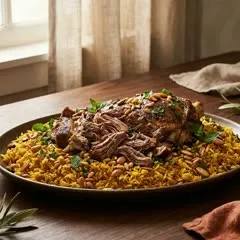
Lamb ouzi$19
Lamb shoulder slow-cooked until it falls apart, over spiced rice with toasted almonds and yoghurt on the side.
The point is cut off
Lamb ouzi$19
A traditional recipe passed down in our family for generations and prepared with love, made with lamb shoulder and rice.
- Lead with the food. Family history and the story of the recipe belong on your About page.
- Write in sentence case. A line in capitals is slower to read on a small screen.
- Let the photo do its share. If the picture shows fries on the plate, the description can spend those words elsewhere.
- Use numbers for portions: four pieces, 180 g, for two. They are short and they answer a real question.
- Read the menu on your own phone, at arm's length, before you publish it.
When your menu is in two languages, write each one for the people who read it and keep the facts identical: the same ingredients, the same allergens, the same portion. A word-for-word translation usually reads badly in the second language, and a loose one can drop the one ingredient that mattered.
English
Fattoush
Tomato, cucumber, radish and purslane in a sumac and pomegranate molasses dressing, topped with crisp fried pita.
العربية
فتوش
بندورة وخيار وفجل وبقلة مع صلصة السماق ودبس الرمان، وفوقها خبز مقلي مقرمش.
- Keep the dish's own name in every language. Write kibbeh, then explain it. “Fried meat balls” loses the dish.
- Pick one spelling for each name in Latin letters, such as knafeh or manakish, and use it everywhere.
- Check the allergens in both versions side by side. This is the mistake that hurts someone.
- Arabic reads right to left, so check that prices and numbers still sit where a reader expects them.
- Ask a native speaker to read the second language aloud. If they stumble, rewrite the line.
On a tamr menu, customers can ask the AI waiter about any dish, and it only talks about what is on your menu. So a description that says what is in a dish and how it is cooked gives better answers. A dish described as “chickpea dip” leaves it with very little to say.
Import shows you the gaps
Upload your menu as a PDF, a photo or a link. tamr reads every dish, price and description, and a Needs column shows any dish that is missing a description.
Allergy answers come from your tags
The AI waiter answers allergy questions from the allergen tags on each dish and always asks the customer to confirm with your staff. It never promises a dish is safe.
A second language, on Pro
Write the menu in one language and choose the others. tamr translates it, and you check and change any line.
Run every dish through this checklist before you print or publish. It takes about two minutes a dish. Start with your ten best sellers, because those are the descriptions most of your customers read and the ones your servers get asked about most.
- 1It says what the dish is without repeating its name.
- 2It says how the dish is cooked or finished.
- 3It has one detail that is true only in your kitchen.
- 4It is between 12 and 25 words.
- 5The deciding ingredient or method is in the first eight words.
- 6Every common allergen in the dish is named.
- 7Vegan, vegetarian or no alcohol is stated where it is true.
- 8No empty words are left: delicious, famous, perfect, assorted.
- 9The portion is clear where customers would ask.
- 10Both languages say the same thing, and a native speaker has read each.
Once the descriptions are right, the next question is what each dish should cost. Read the menu pricing guide
How do you write a menu description?
Write three things in under about 25 words: what the dish is, how it is made, and what makes yours different. Name the main ingredients a customer would want to know about, including any common allergen. For example: “Chickpeas blended with tahini and lemon until smooth, finished with olive oil and toasted pine nuts. Served with warm bread.”
How long should a menu description be?
Aim for 12 to 25 words, which is one or two lines on a phone. Shorter than that and customers have to ask what is in the dish. Longer and they stop reading before the end. Put the most important ingredient or the cooking method in the first six to eight words, because a phone screen may cut the rest.
What words should I avoid in menu descriptions?
Avoid words that give no information: delicious, tasty, yummy, amazing, world-famous, best in town, cooked to perfection, mouth-watering. Be careful with fresh, homemade and authentic unless you can say what makes them true. Replace each one with a fact, such as where an ingredient comes from, how long the dish is cooked, or how it is finished.
Should allergens go in the menu description?
Yes, name the ingredient in the description when it is one people react to, such as nuts, sesame, milk, egg, wheat, fish or shellfish. Watch the hidden ones: tahini is sesame, kibbeh contains wheat, and Caesar dressing contains fish and egg. A description does not replace your legal allergen information, so follow the rule in your country as well.
How do I write a menu description for a dish like tiramisu or hummus?
Use the same formula for any dish. Tiramisu: “Ladyfingers soaked in espresso, layered with mascarpone cream and dusted with cocoa. Made here every morning. Contains raw egg.” Hummus: “Chickpeas blended with tahini and lemon until smooth, finished with olive oil and toasted pine nuts.” The guide has 32 examples across starters, mains, desserts and drinks.
How do I write menu descriptions in two languages?
Write each language for the people who read it, and keep the facts the same in both: the same ingredients, the same allergens, the same portion. Keep the dish's own name, such as fattoush or knafeh, and explain it in the description. Have a native speaker read the second language before you publish.
Does the description change what tamr's AI waiter says?
Yes. The AI waiter only talks about what is on your menu, so it answers from your dish names, descriptions, prices and tags. A description that says what is in the dish and how it is cooked gives it more to answer with. Allergy answers come from the allergen tags you set on each dish, and the AI waiter always asks the customer to confirm with your staff.
Upload your menu as a PDF or a photo, or import it from a link. tamr reads your dishes and descriptions, and your customers can start asking the AI waiter the same day.